Google has quietly changed how customers get information about local businesses, and most business owners haven’t realized the impact yet.
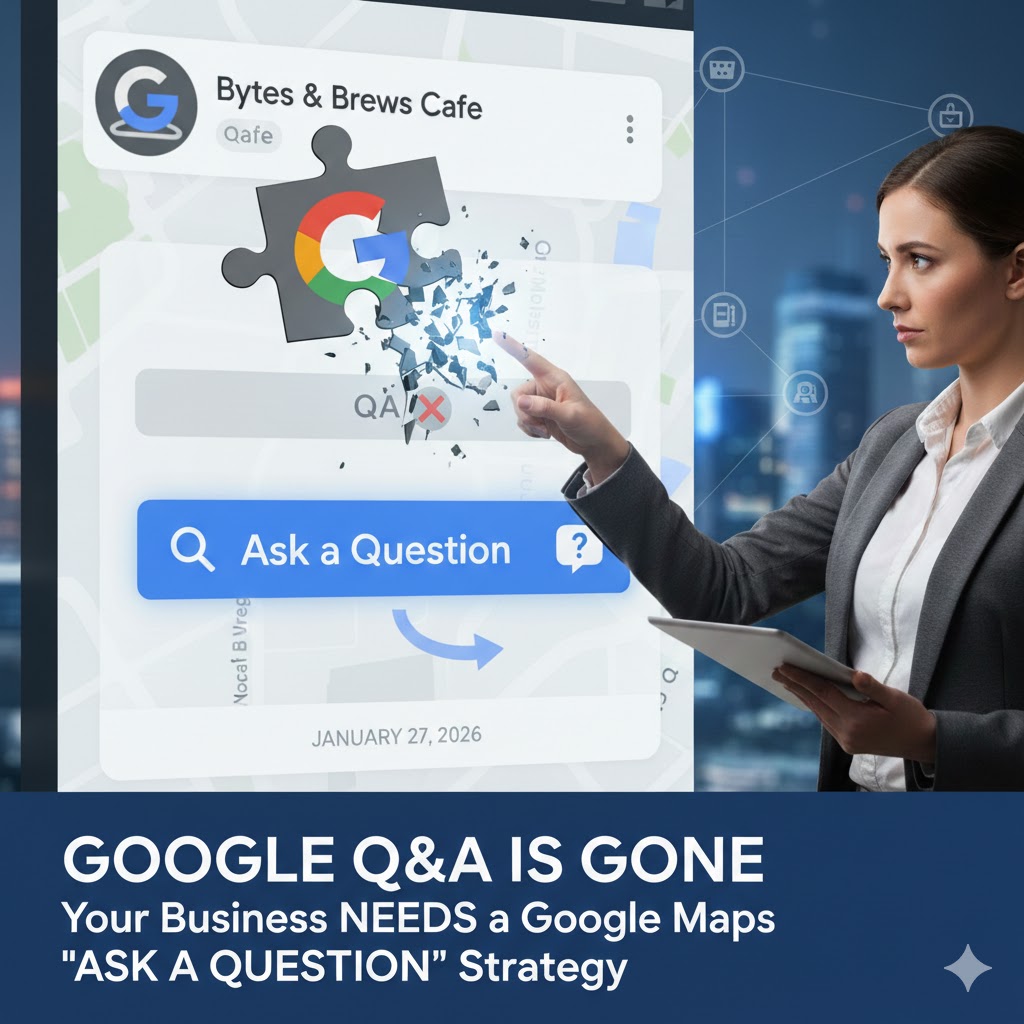
The traditional Google Business Profile Q&A feature — where users could publicly ask questions and businesses could respond — has effectively disappeared from Google Search. In its place, Google is rolling out a new AI-powered “Ask a Question” experience, primarily inside Google Maps. Instead of human answers, users now receive AI-generated responses created by Google’s systems.
This isn’t just a UI update. It’s a fundamental shift in local search.
At Magnet Marketing SEO, we see this as one of the most important changes to local SEO in years, because it removes direct control from business owners and places your brand’s reputation in the hands of Google’s AI.
What Actually Replaced Google Q&A

When a user taps the “Ask a Question” feature in Google Maps, Google’s AI attempts to answer automatically. There is no moderation panel, no business-owner response field, and no manual correction process. The system pulls data from sources Google already trusts: your Google Business Profile, your website, customer reviews, images, listed services, business attributes, and category data.
If those sources are clear, consistent, and optimized, the AI gives helpful answers. If they’re incomplete, outdated, or poorly structured, the AI fills in the gaps on its own — and that’s where misinformation and missed opportunities happen.
This means Google is still answering customer questions, but businesses are no longer part of the conversation.
Why This Matters More Than Most Businesses Realize
In the old system, business owners could control the narrative. You could answer common questions, clarify pricing expectations, explain service areas, and address objections before a customer ever called. That control is gone.
Now, Google decides what customers learn about your business.
If your data is weak, Google’s AI may misunderstand your services, misrepresent what you offer, or fail to communicate your value clearly. That doesn’t just affect visibility — it affects trust, conversions, and buying decisions.
From a marketing perspective, this is a shift from answer management to data authority. You no longer manage responses. You manage the information ecosystem that trains Google’s AI.
The New Strategy: Training Google’s AI Instead of Answering Customers
At Magnet Marketing SEO, we call this the “Ask a Question Strategy.” It’s not about questions anymore — it’s about building a data foundation so strong that Google’s AI has no confusion about who you are, what you do, and why customers should choose you.
Google’s AI learns through repetition and consistency across trusted sources. When your brand sends the same signals everywhere, the AI becomes confident. When your signals conflict, the AI guesses.
This means your digital presence must function as a single unified system, not disconnected marketing assets.
How Google’s AI Understands Your Business
Google builds its understanding of your business through layered signals. Your Google Business Profile is the core source, but it doesn’t work alone. Your reviews provide language patterns about your services and customer experience. Your photos give visual confirmation of professionalism, services, and physical presence. Your website explains your offerings, service areas, and positioning. Your categories and attributes define relevance.
When all of these elements reinforce each other, Google’s AI produces accurate, confident answers. When they contradict or lack depth, Google’s AI fills the gaps with assumptions.
This is why thin profiles, generic website copy, and inconsistent service descriptions are no longer just SEO issues — they are AI risk factors.
Where the “Ask a Question” Feature Is Appearing
The AI-powered Ask a Question experience currently appears more prominently in Google Maps and is rolling out unevenly across industries and locations. Some categories see it more frequently than others, but the direction is unmistakable.
Google is moving toward AI-first local search experiences, where users interact with systems instead of interfaces. This is not a temporary experiment — it’s a structural shift.
The Opportunity for Businesses That Get This Right
For businesses that invest in strong optimization, this change can become a competitive advantage. Clear data leads to better AI answers. Better AI answers lead to stronger trust. Stronger trust leads to higher conversions.
For businesses that ignore it, the opposite happens. Confusion replaces clarity. Visibility turns into invisibility. Traffic turns into lost opportunities.
The gap between optimized brands and neglected brands will grow — not shrink.
What Magnet Marketing SEO Helps Businesses Do
At Magnet Marketing SEO, we don’t treat this as a feature update. We treat it as a new local search operating system.
Our focus is building structured digital authority through:
• Fully optimized Google Business Profiles
• Review strategy and semantic review signals
• Service-based content clarity
• Local SEO structure
• Website content that communicates value and relevance clearly
• Consistent data across every platform Google trusts
This approach doesn’t just improve rankings — it improves how Google’s AI understands and represents your business.
Final Perspective
Google Q&A didn’t disappear. It evolved.
Questions didn’t stop — control did.
Today, Google’s AI decides what customers learn about your business before they ever call, click, or visit your website. That means your brand story is being told whether you participate or not.
The only real choice is whether Google’s AI tells that story accurately — or incorrectly.
At Magnet Marketing SEO, we help businesses take control of that narrative by building digital ecosystems that Google understands, trusts, and promotes.
Because in the AI era of local search, clarity is currency — and authority wins.